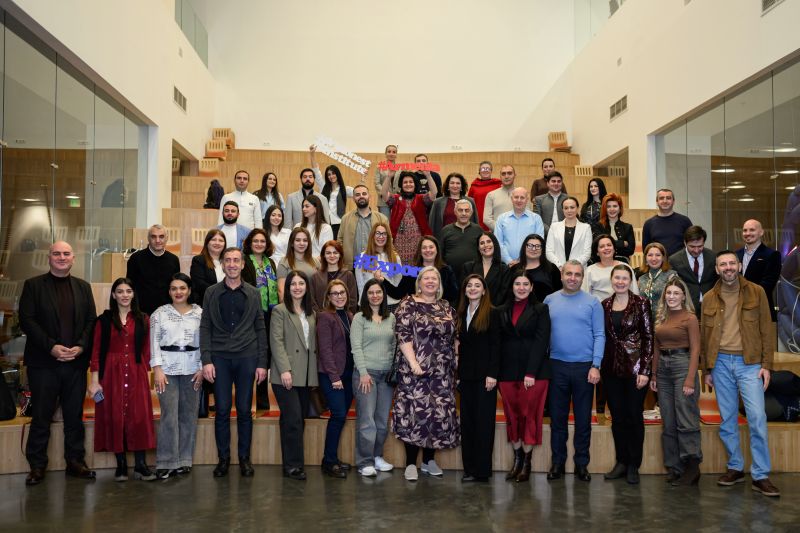
The program was implemented by the Visionest Institute with funding from the Estonian Centre for International Development (ESTDEV).
See more pictures from Linkedin or look into the full gallery!
Visionest Institute CEO Anu-Mall Naarits highlighted trust and partnership as the foundation of successful export strategies. Addressing the graduates, she noted that many participants had placed their confidence in a team from Estonia they barely knew at the outset:
“Partnership is one of the most important things in export, and this trust was the starting point of everything,” she said, adding that the trainers had delivered on their promise to equip businesses with new tools and practical approaches for entering foreign markets.
From the policy side, the Ministry of Economy underscored the program’s role in Armenia’s broader export agenda. Nune Azizyan, Head of the Export Promotion Department, emphasized that Visionest Institute’s expertise and consistent work are helping Armenian companies “reach a new level in exports,” and stressed the importance of continued collaboration between government and education providers.

For Estonia, the initiative is part of a wider strategy to share know-how from its own transformation into a digital and entrepreneurial hub. Martin Aadamsoo, Program Manager for Entrepreneurship, Innovation, and Green Transition at ESTDEV, pointed to the importance of diversification for small economies:
“We’ve succeeded in being a startup nation, we’ve succeeded in being an educational powerhouse,” he said, expressing confidence that the training had given Armenian SMEs the foundations they need to compete internationally. While cautioning that the path ahead “is not going to be easy,” he underlined that the rewards of persistent effort in export markets are substantial.
The European Union also signaled strong interest in Armenia’s export potential. Speaking at the event, Josip Jurić, Representative of the EU Delegation to Armenia, voiced optimism about seeing more Armenian products in European markets and encouraged participants to make use of ongoing support if initial attempts prove challenging.
A key feature of the program was its practical orientation. Over the three months, participants developed and refined concrete business plans tailored to export growth. These plans were presented at the graduation, showcasing a pipeline of Armenian companies preparing to move from theory to execution.
Positioned at the crossroads of business education and economic development, the Export Training Program illustrates how targeted, skills-based initiatives—backed by international cooperation—can help small economies expand their global footprint. For the graduating cohort of Armenian SMEs, the ceremony at Tumo marked not an endpoint, but the beginning of their next phase: testing newly acquired knowledge in real export markets.