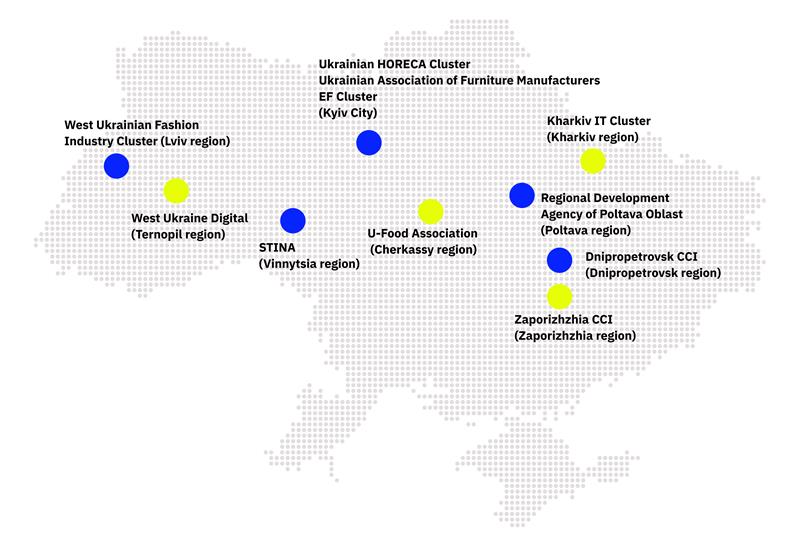
Following the program’s conclusion, we conducted exit interviews with 10 participating teams to capture what has changed, what is currently being applied, and what is now possible for the wider SME ecosystem.
A clear pattern emerged: the program did more than improve individual competencies within BSOs. It strengthened the regional SME export ecosystem by refining how export opportunities are identified, how companies are prepared for buyers, and how market entry efforts are coordinated across institutions and sectors.

1. Ecosystem impact starts with stronger “first-line export infrastructure”
Across the interviews, BSOs described a step-change in their ability to function as “first-line export infrastructure” for SMEs. This means companies can now access structured export support locally, without relying exclusively on central institutions or external consultants.
In practical terms, BSOs reported that they can now:
- Guide SMEs through a clearer export pathway using “step-by-step” market entry logic.
- Conduct stronger market screening and evidence-based prioritization.
- Translate analysis into actionable export plans and outreach strategies.
- Advise on positioning, pricing logic, and distribution approaches.
Why this matters: This raises the baseline at the ecosystem level. It increases the volume and quality of export-capable SMEs in the pipeline, rather than relying on just a few isolated success stories.
2. Spillover effects: Benefits reached beyond the SMEs directly mentored
A recurring theme was that the knowledge gained through Export Alliance Mastery did not remain siloed within the cohort. BSOs described actively transferring tools and materials into their daily workflows—meaning many more companies benefited than just those directly involved in the program assignments.
Examples from the interviews included:
- Sharing training presentations and templates with wider member bases.
- Using improved methods in regular consultations.
- Applying new approaches in regional projects and partner programs.
- Offering new services, such as market research hubs and delegation preparation.
Why this matters: This “multiplier effect” is a core indicator of ecosystem strengthening. A single improved BSO capability can influence dozens—and over time, hundreds—of SMEs.
3. Market-facing readiness improved: SMEs are showing up better prepared
Several interviews emphasized a practical change often overlooked in export support: SME readiness is frequently limited by marketing and product presentation, not ambition.
BSOs described helping SMEs improve:
- Buyer-facing product descriptions and specifications.
- Catalogues, visuals, and video materials.
- Packaging and competitor differentiation.
- Clarity of offering (e.g., sizes, materials, assembly requirements).
- Confidence in presenting to international partners.
Why this matters: Stronger readiness reduces “failed” meetings and increases the probability that exporter efforts convert into follow-up actions, such as sample requests, distributor talks, and contract negotiations.
4. Real market traction: Partner outreach, samples, and early contract pipelines
Across interviews, BSOs shared concrete examples of market traction that emerged from their improved support:
- Companies progressing into foreign markets, including North America and the EU.
- Meetings with distributors and buyers based on structured planning rather than opportunistic exposure.
- Companies actively preparing samples and value propositions.
- Strategic shifts toward feasible entry models (e.g., using private labeling as a lower-risk pathway).
- Strengthened trust after resolving real-world challenges, such as handling logistics delays professionally.
Why this matters: These are not isolated wins; they represent the ecosystem’s ability to absorb shocks and still progress through market entry stages.
5. Stronger connectivity: BSOs are coordinating value chains and reducing fragmentation
A particularly important outcome was improved coordination across organizations. Interviews highlighted instances of BSOs referring cases to one another, cooperating on bids, aligning initiatives, and building practical working relationships across sectors.
Why this matters: In Ukraine’s current context, the ecosystem cannot afford duplicated efforts or isolated support silos. Stronger coordination increases reach, reduces waste, and helps SMEs access the right expertise faster.
6. Ecosystem instruments are emerging: Catalogues, platforms, and delegations
Beyond one-to-one consulting, BSOs described building or contributing to lasting ecosystem-level tools and formats:
- Export potential catalogues and regional promotion.
- Market-facing platforms connecting companies internationally.
- Exporter forums and conferences to re-activate demand and learning cycles.
- Delegation models that connect companies to target-market partners and institutions.
Why this matters: These instruments create shared infrastructure. Once established, they can serve many companies repeatedly, creating long-term value.
The context remains difficult, but the ecosystem is adapting
The interviews remained realistic about constraints: security risks, electricity disruptions, logistics volatility, staff shortages, and contracting uncertainty all slow the conversion of opportunities into deals.
However, the dominant message was that SMEs still need export routes to survive and grow. Crucially, BSOs are increasingly able to help companies move forward despite these constraints by utilizing more appropriate market entry models and stronger planning.
Closing Reflection
Export Alliance Mastery strengthened BSO teams—but more importantly, it strengthened the SME export ecosystem around them. The result is better local export infrastructure, stronger readiness, clearer pipelines, and improved coordination across institutions and sectors.
Visionest Institute remains committed to supporting Ukrainian organizations and SMEs as they build sustainable, market-facing capabilities. Our goal is to ensure that export becomes not an exceptional achievement, but a scalable pathway for regional growth and resilience.
Export Alliance Mastery: Центр розвитку Експортної Потужності project is developed by Visionest Institute Estonia and implemented in cooperation with Ukraine’s Entrepreneurship and Export Promotion Office within the framework of the Diia. Business Ukrainian national project. The project is supported by ESTDEV – Estonian Centre for International Development
